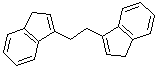
1,2-Bis(3-indenyl)ethane is a hydrocarbon precursor with two indene units joined by a two-carbon bridge. Each indene combines a benzene ring with a five-membered ring containing unsaturation. The formula C₂₀H₁₈ describes the neutral material. No metal appears in that formula, an important point when the compound is encountered in a catalog of metallocene-related reagents.
A patent devoted to preparing bisindenylalkanes explicitly identifies this compound as an intermediate for metallocene catalysts. Those catalysts can be used with a suitable cocatalyst in stereoselective olefin polymerization. The connection to polymers is therefore documented, but it belongs to a sequence of chemical transformations. The neutral hydrocarbon must not be described as though it were already a metal complex or a complete active polymerization system.
The two-carbon bridge gives the precursor its broader significance. In bridged, or ansa, metallocene chemistry, a tether constrains how two ring ligands can be arranged around a metal. This changes the spatial environment experienced by an approaching monomer. The relationship between catalyst geometry and the orientation of repeated monomer insertions is central to controlling polymer stereochemistry. However, the identity and configuration of the eventual metal complex, as well as the activation system, are needed before assigning an actual polymerization outcome.
The neutral precursor and a metal-bound indenyl ligand also use different descriptions of bonding. Deprotonation and metal coordination change the electronic situation of the ring system. An aromatic ring shown in the starting hydrocarbon is therefore not a complete picture of the coordination present in a later catalyst. Naming a family resemblance does not specify the metal's oxidation state, the ligand arrangement or the active species.
Its supported application is preparative access to a constrained ligand framework. The patent treats the synthesis of that framework as a practical issue in making catalyst precursors, while the registry identifies which hydrocarbon is being discussed. The interesting scientific link is between a small ethylene bridge and the geometry of a much larger catalytic assembly, without attributing the assembly's measured behavior to the starting hydrocarbon alone.
References:
1. PubChem. 1,2-Bis(3-indenyl)ethane, CID 3488033. https://pubchem.ncbi.nlm.nih.gov/compound/3488033
2. US Patent 6414206 B2. Process for preparing bisindenylalkanes. https://patents.google.com/patent/US6414206B2/en
|





 GHS07 Warning Details
 chemBlink Chemical Story