
Online Database of Chemicals from Around the World
| Wuhan Carnoss Technology Co., Ltd. | China | |||
|---|---|---|---|---|
 | www.carnoss.com | |||
 | +86 18064039730 | |||
 | +86 (27) 8349-6462 | |||
 | frank@carnosschem.com | |||
 | WeChat: kanuosi_wxid | |||
| Chemical manufacturer since 2012 | ||||
| chemBlink Standard supplier since 2018 | ||||
| Classification | Biochemical >> Amino acids and their derivatives |
|---|---|
| Name | Lauroyl Glutamic Acid |
| Synonyms | (2S)-2-(dodecanoylamino)pentanedioic acid |
| Molecular Structure | 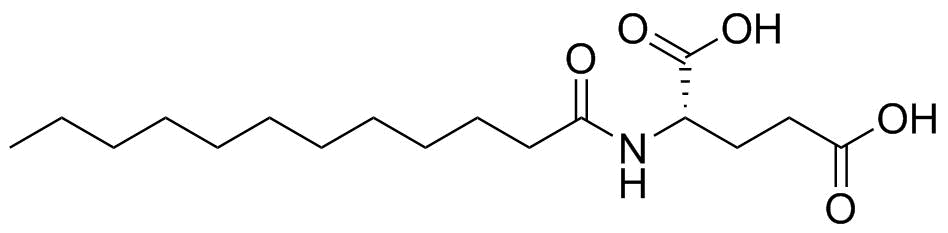 |
| Molecular Formula | C17H31NO5 |
| Molecular Weight | 329.43 |
| Protein Sequence | E |
| CAS Registry Number | 3397-65-7 |
| EC Number | 222-261-1 |
| SMILES | CCCCCCCCCCCC(=O)N[C@@H](CCC(=O)O)C(=O)O |
| Density | 1.1±0.1 g/cm3 Calc.* |
|---|---|
| Boiling point | 543.6±40.0 °C 760 mmHg (Calc.)* |
| Flash point | 282.6±27.3 °C (Calc.)* |
| Index of refraction | 1.486 (Calc.)* |
| * | Calculated using Advanced Chemistry Development (ACD/Labs) Software. |
| Hazard Symbols |  GHS07 Warning Details GHS07 Warning Details |
|---|---|
| Risk Statements | H302-H315-H319-H335 Details |
| Safety Statements | P261-P305+P351+P338 Details |
| SDS | Available |
 chemBlink Chemical Story
|
What happens when a fatty acid is attached to an amino acid? Lauroyl glutamic acid, more precisely N-lauroyl-L-glutamic acid, answers that question by turning two familiar biological building blocks into an amphiphile. The molecule combines the C12 chain of lauric acid with the amino group of L-glutamic acid through an amide bond. The lauroyl chain is strongly hydrophobic. Glutamic acid contributes two carboxylic-acid groups and a chiral amino-acid framework. In its neutral acid form the molecule is relatively lipophilic, while conversion to sodium or other salts ionizes the carboxyl groups and greatly increases water compatibility. This tunability is why glutamate surfactants appear as acids, mono-salts, and di-salts with different formulation behavior. The design belongs to a broader class of amino-acid-based surfactants. Instead of building the polar head group from sulfate, sulfonate, or a polyoxyethylene chain, chemists use an amino acid whose carboxylate groups can interact with water. The amide linkage between the amino acid and fatty acyl chain is also chemically familiar from peptides and lipids. The result is a surfactant architecture that is immediately recognizable to both organic chemists and biochemists. Lauroyl glutamic acid and its salts are used in cosmetic and personal-care formulations as surface-active and conditioning ingredients. The sodium salts are especially associated with mild cleansing systems. Their behavior arises from the same molecular conflict found in every surfactant: the hydrocarbon chain avoids water while the ionized glutamate head seeks it. At interfaces, that conflict becomes useful, lowering interfacial free energy and allowing oily material, water, and air to be organized into micelles, emulsions, foams, or other self-assembled structures. The glutamate head group also makes the molecule responsive to pH. As the carboxylic acids gain or lose protons, charge, solubility, and aggregation can change. That is one reason formulators cannot treat "lauroyl glutamate" as a single behavior independent of pH, counter-ion, and concentration. A cleanser containing sodium lauroyl glutamate is chemically related to lauroyl glutamic acid, but it is not the same ionic state. Safety assessments of amino-acid alkyl amides, including lauroyl glutamic acid and related glutamates, have supported their cosmetic use under current conditions when products are formulated to be non-irritating. The broader attraction is conceptual as well as practical: a natural amino-acid motif and a fatty-acid chain can be joined to create a modern surfactant. Lauroyl glutamic acid is therefore memorable as a molecular hybrid. One half resembles a lipid tail, the other an amino acid. Joining them through an amide bond creates a molecule that can organize at surfaces - an example of how familiar pieces of biochemistry can be recombined into useful materials chemistry. References: 1. PubChem, Lauroyl Glutamic Acid, CID 93133, CAS 3397-65-7. 2. Cosmetic Ingredient Review. Safety Assessment of Amino Acid Alkyl Amides as Used in Cosmetics. International Journal of Toxicology. 2017, 36(Suppl. 1), 17S-56S. 3. European Chemicals Agency (ECHA), N-(1-oxododecyl)-L-glutamic acid, EC 222-261-1. 4. Literature on amino-acid-based surfactant self-assembly and glutamate surfactants. |
| Market Analysis Reports |