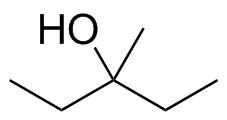
3-Methyl-3-pentanol is a compact tertiary alcohol whose structure provides a useful lesson in how carbon skeletons control alcohol chemistry. The carbon bearing the hydroxyl group is attached to two ethyl groups and one methyl group, so it has no hydrogen directly attached to that carbinol carbon. This makes the molecule a tertiary alcohol and distinguishes its oxidation and substitution behavior from primary and secondary alcohols.
A classic route to such a structure is the Grignard reaction. An ester such as methyl acetate can react twice with ethylmagnesium halide: the first addition passes through a ketone-like intermediate, and the second creates the tertiary alkoxide that yields 3-methyl-3-pentanol after work-up. Alternatively, an appropriate ketone can undergo a single Grignard addition. These reactions made tertiary alcohols textbook demonstrations of carbon-carbon bond formation because the product skeleton can often be predicted directly from the carbonyl compound and organomagnesium reagent.
The molecule also illustrates why tertiary alcohols resist the simple oxidation pattern learned for ethanol or 2-propanol. Oxidizing a primary alcohol can produce an aldehyde or acid, and a secondary alcohol can produce a ketone, because the carbon bearing OH also bears a removable hydrogen. 3-Methyl-3-pentanol lacks that hydrogen. Strong oxidation therefore requires carbon-carbon bond cleavage rather than straightforward dehydrogenation to a carbonyl compound. By contrast, acid-catalyzed dehydration is comparatively natural: protonation of OH followed by water loss can generate a stable tertiary carbocation and lead to substituted alkenes.
Historically, branched tertiary alcohols also appeared as building blocks and intermediates in pharmaceutical and fine-chemical manufacture. Their value lies less in one famous end use than in the predictable combination of steric bulk, hydroxyl functionality, and tertiary-carbon reactivity. The alcohol group allows conversion to esters, ethers, halides, or alkenes, while the branched carbon framework is retained or deliberately reorganized.
3-Methyl-3-pentanol matters because it is a small molecule that makes reaction-class logic unusually visible. Its synthesis demonstrates how organometallic reagents construct C-C bonds; its oxidation resistance reveals the importance of a single missing C-H bond; and its dehydration shows why carbocation stability changes reaction pathways. In a bottle it is merely a colorless tertiary alcohol, but on paper it is almost a miniature lesson in classical organic chemistry.
References:
NIST Chemistry WebBook. 3-Methyl-3-pentanol, CAS 77-74-7.
Lide DR, ed. CRC Handbook of Chemistry and Physics.
March J, Smith MB. March's Advanced Organic Chemistry. Wiley.
|







 GHS02;GHS07 WarningGHS02; Details
 chemBlink Chemical Story